
Book launch
Humanities Perspectives on AI
An Interdisciplinary Introduction
Lukas R.A. Wilde, Miriam Kyselo, Thomas Brandt, Guri Hanem and Roger A. Søraa (eds.)
-
Place
Aschehoug forlag, Sehesteds gata 3, Oslo
-
Time
14. September 16.00-18.00
-
Open for all
Requires registration for attending, but no registration fee.
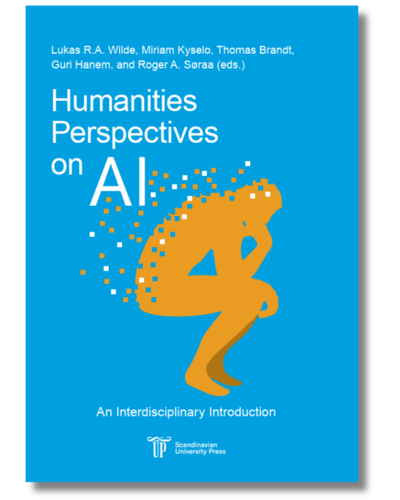
This afternoon we are celebrating the launch of the new book, Humanities Perspectives on AI.
Join us and listen to reflections by the editors, short presentations of the contributions and panel discussion. Professor of Media Aesthetics and Textual Theory and Analysis, Liv Hausken from University of Oslo will moderate and lead us through the event.
Welcome!
About the book
Today Artificial Intelligence (AI) is deeply embedded in everyday life, both at the personal and professional level. More than ever, there is a fundamental need to go beyond the hype and offer a nuanced reflection on AI’s possibilities and limitations—and on how these technologies affect us in the social, cultural, and political contexts we live in. The most urgent challenges concern questions of human agency, creativity, and responsibility, spanning domains from science to society, politics, and the arts. Addressing these challenges requires a novel, humanities-based perspective that complements a technological understanding with foundational inquiries into what it means to be human and how we generate meaning.
This timely collection provides an interdisciplinary introduction to these questions, bringing together history, philosophy, ethics, linguistics, science and technology studies, media studies, as well as music and literature. The authors demonstrate that the humanities are not only challenged by AI but provide indispensable tools for understanding and reflecting our stance on it. Readers will thus gain not only a broad methodological grounding but also nuanced insight into concrete cases, leaving them better informed and aware that their own perspective on AI is not only valid, but indispensable. The hype surrounding AI thrives on the assumption that its trajectory is already written. This book is an invitation to question that assumption—and to imagine otherwise.
The book is available with open access at Scup.com: https://www.scup.com/doi/book/10.18261/9788294167234-26
Organizer: Scandinavian University Press
Book review
“This is a timely and welcome contribution. It does not promise answers—which is appropriate, as many answers do not yet exist—but instead offers a grounded and open way into the study of AI technology from a humanities perspective. I wholeheartedly recommend this book to anybody somehow interested in or affected by this societal development; which is to say everybody.”